By Jared Shoops, MD, Resurgens Orthopaedics
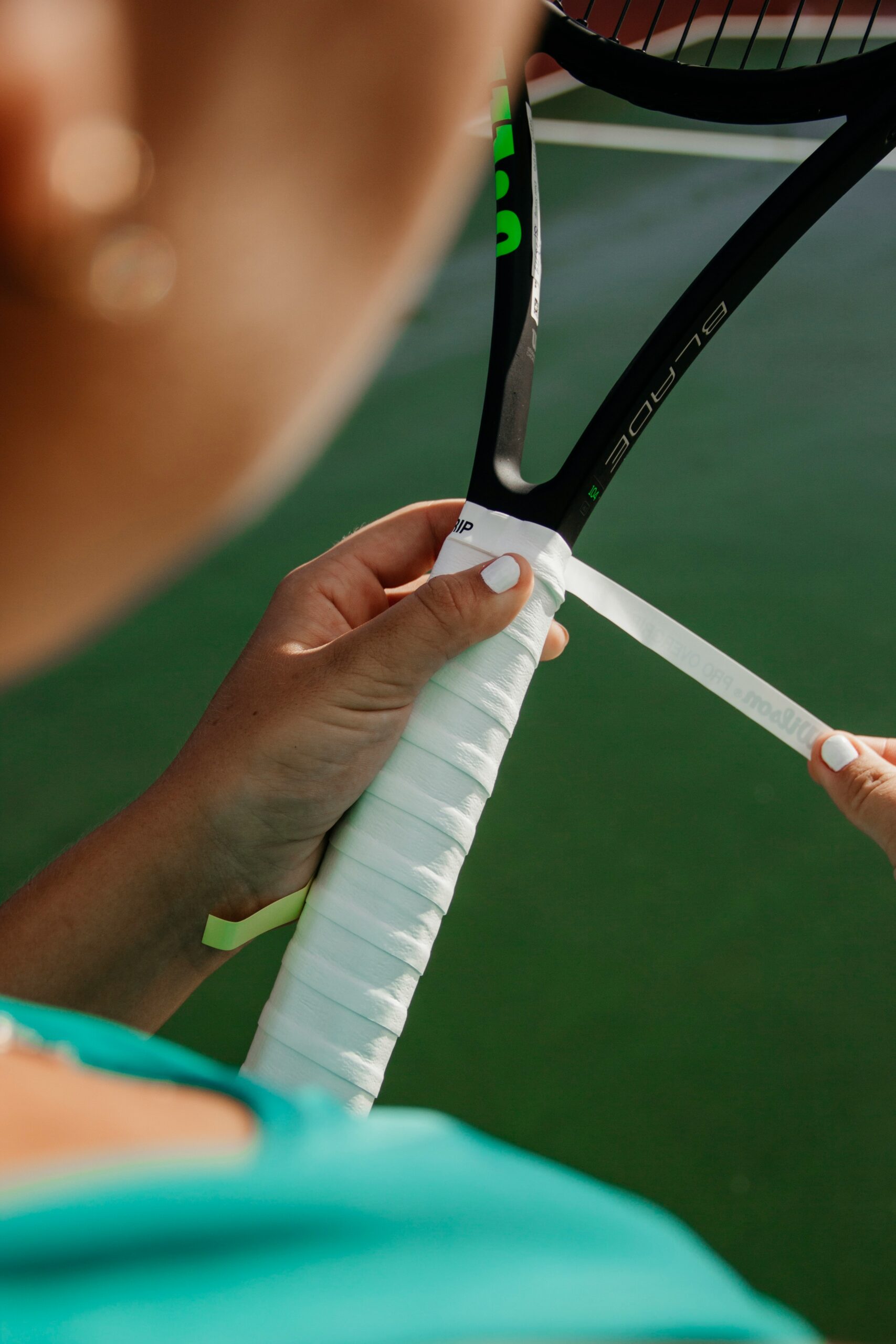
For tennis players, choosing a racquet often comes down to feel. How easily can you maneuver it? Does it give you the control, power and spin you’re looking for? But there’s another part of racquet setup that’s easy to overlook, and it may play a role in hand, wrist, and elbow symptoms: grip size. While no single grip size can prevent injury, finding the right fit can help balance comfort, control, and the demands of a player’s game.
Why are tennis grips getting smaller?
Traditionally, tennis players often were steered toward larger grips, particularly when dealing with lateral epicondylitis (tennis elbow). The thinking was that a larger handle might reduce how tightly a player needed to squeeze the racquet. Today, as technology has evolved, many players have gravitated toward smaller grips, which can provide greater freedom of the hand and wrist, i.e., easier racquet manipulation.
A 2009 Tennis Magazine article documented this shift, linking smaller grips in part to lighter racquets and an increased emphasis on racquet-head speed and spin: “…choosing a smaller grip simply because that is what high-level players are doing isn’t necessarily the answer. Grip size is very individual, and the goal should be finding a size that allows you to swing freely while still controlling the racquet without excessive grip pressure.”
What does grip size mean for your wrist and elbow?
A smaller grip does not automatically cause tennis elbow, and a larger grip is not a cure. Technique, playing volume, racquet characteristics, strings, and individual anatomy also play a role. Research supports an individualized approach. A 2006 study of collegiate tennis players found no significant difference in forearm muscle activity when using the recommended grip size or grips ¼ inch smaller or larger. A 2014 study examining grip force and wrist loading also suggested that optimal grip diameter may vary by player.
Grip size can affect the wrist, too. A grip that is too small may move more within the hand and lead some players to squeeze harder for control. Repetitive gripping, rotation, and loading can contribute to symptoms involving the triangular fibrocartilage complex, or TFCC.
The TFCC is an important stabilizer on the small-finger side of the wrist. Going too large is not necessarily better. An oversized grip can limit comfortable hand and wrist movement, make quick grip changes more difficult, and place the hand and forearm in a less natural position. The goal is to find the right balance between comfort, control, and the demands of the player’s game.
Finding the right grip for your game
The traditional method for estimating grip size is to hold the racquet and see whether approximately a finger’s width fits between the fingertips and palm. That remains a useful starting point, but not an absolute rule. The right grip should allow a player to swing comfortably and maintain control without excessive squeezing. If the racquet feels unstable unless held tightly, or the handle feels cumbersome and restricts movement, it may be worth reassessing the size.
When a grip change isn’t enough
Adjusting equipment may help, but it isn’t a substitute for diagnosing and treating an injury. TFCC-related wrist pain may initially be managed with activity modification, bracing, anti-inflammatory medication and therapy — with injections considered if symptoms persist. Tennis elbow also is commonly treated without surgery, with activity modification and therapy forming the foundation of treatment. If pain continues, worsens or interferes with play, it may be time to look beyond the racquet and determine the underlying cause.
About the author
Dr. Shoops’ connection to tennis extends beyond the operating room. He won a national championship with the University of Georgia club tennis team in 2013 and continues to compete in ALTA today. In 2026, he also participated in the 29th Annual Kids’ Chance of Georgia Tennis Tournament, and the Kyle Pease Foundation’s For the Love of Inclusion Tennis & Pickleball Tournament, supporting local charitable causes. If hand, wrist or elbow pain is interfering with your game, the specialists at Resurgens Orthopaedics can help. Schedule online today at Resurgens.com.
Article references:
Hatch GF III, Pink MM, Mohr KJ, Sethi PM, Jobe FW. The Effect of Tennis Racket Grip Size on Forearm Muscle Firing Patterns. American Journal of Sports Medicine. 2006;34(12):1977–1983.
Rossi J, Vigouroux L, Barla C, Berton E. Is tennis racket grip size related to tennis elbow? Scandinavian Journal of Medicine & Science in Sports. 2014;24:e462–e470. This gives us the complementary argument that an individualized optimal grip diameter can affect grip force and extensor loading.
McGrogan E. The Incredible Shrinking Grip. Tennis Magazine. 2009. This is our historical/performance reference documenting the move toward smaller grip sizes and why tennis was moving in that direction.